
If you have been researching Peyronie’s Disease, you likely already know the basics: it involves the formation of scar tissue (plaque) that causes a curved, often painful erection. You might even be familiar with the standard treatment options. However, recent clinical research is shifting the focus from simply “managing symptoms” to actually remodeling the underlying tissue at a cellular level.
By looking at data from leading medical technology manufacturers like Medispec, we can uncover new ways to address Peyronie’s Disease through the power of advanced acoustics. Here are 7 research-backed insights into the evolution of Peyronie’s Disease treatment.
1. The Power of “Angiogenesis” in Tissue Repair
The hallmark of Peyronie’s Disease is the presence of inelastic fibrous plaque. Clinical research from Medispec highlights that Low-Intensity Extracorporeal Shock Wave Therapy (Li-ESWT) triggers angiogenesis, the formation of new blood vessels. By improving blood flow to the affected area, the body is better equipped to support the healing of damaged cavernous tissue.
2. Why “Plaque Lysis” is the New Treatment Goal
Unlike medications that offer temporary relief, shockwave technology targets the “pathophysiology” of the condition. Scientific studies suggest that focused shockwaves create an inflammatory response that increases macrophage activity. These specialized cells essentially “clean up” the area, leading to the lysis (breakdown) and resorption of the plaque causing your Peyronie’s Disease.
3. A 57% Stabilization Rate in Chronic Cases
In a preliminary report published on PMC, researchers found that the majority of patients seeking treatment for Peyronie’s Disease (roughly 57%) were in the stable phase (12–23 months post-onset). The study showed that even in these chronic stages, non-invasive shockwave therapy offered significant improvement in penile curvature and pain scores without the need for surgery.
4. The 0.09 mJ/mm² Energy Standard
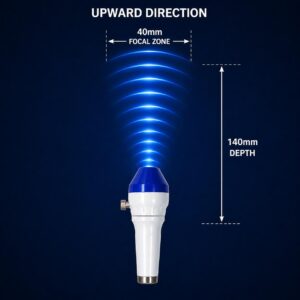
Not all shockwave machines are created equal. Medispec’s ED1000 uses a specific energy density of 0.09 mJ/mm². This “sweet spot” of energy is powerful enough to stimulate tissue remodeling in Peyronie’s Disease patients but gentle enough to be performed in an office setting without anesthesia or downtime.
5. Overcoming the “Dual Burden” of ED and Peyronie’s
Clinical data suggests that approximately 75% of men with Peyronie’s Disease also experience some form of erectile dysfunction. This is because the plaque acts as a physical barrier to blood flow. By utilizing the Medispec ED1000 protocol, patients often see a “dual recovery”—addressing both the curvature and the vascular health required for a firm erection.
6. Shifting “Non-Responders” to “Responders”
One of the most exciting breakthroughs in Peyronie’s Disease research is the ability to help men who have stopped responding to oral medications (PDE5 inhibitors). Studies have shown that after a course of shockwave therapy, over 70% of previously “end-stage” patients became responsive to traditional treatments again.
7. Zero “Systemic Load” on the Body
Traditional treatments for Peyronie’s Disease can include injections or surgeries that carry risks of scarring or long recovery times. Research confirms that Li-ESWT has no reported adverse effects on reproductive or hormonal function. It is a localized, “mechanotherapy” that works exactly where the plaque is located, without affecting the rest of the body.
Reclaim Your Confidence
Understanding the science behind Peyronie’s Disease is the first step toward effective recovery. With the advent of technologies like the Medispec ED1000, the focus has moved away from “living with the curve” and toward a future of natural, non-invasive tissue repair.
If you are struggling with the symptoms of Peyronie’s Disease, consult with us to see if shockwave therapy is the right clinical path for you.
To learn more about the research, visit the Medispec Clinical Info center.