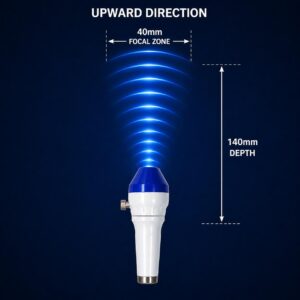

For men diagnosed with Peyronie’s Disease (PD), the journey often begins with a mixture of confusion and frustration. The physical manifestation of the condition, a noticeable curvature, loss of length, or painful erections, is caused by the development of fibrin-rich scar tissue known as plaque. Historically, treatment options were limited to “watchful waiting,” invasive surgery, or series of uncomfortable injections.
However, the medical landscape has shifted. Today, Li-ESWT for Peyronie’s plaque reduction (Low-Intensity Extracorporeal Shockwave Therapy) has emerged as a premier non-invasive solution. By utilizing acoustic energy to trigger biological healing, this technology offers a way to address the root cause of the deformity without the risks of the operating table.
The Biological Blueprint: How Does It Work?
To understand why Li-ESWT for Peyronie’s plaque reduction is so effective, one must first understand the nature of the plaque itself. Unlike normal skin scars, Peyronie’s plaque forms in the tunica albuginea, a pressurized envelope of tissue. This plaque is rigid, preventing the penis from expanding symmetrically during an erection.
When a clinician administers Li-ESWT for Peyronie’s plaque reduction, they are not simply “vibrating” the area. They are delivering targeted pulses of energy that move faster than the speed of sound. This process initiates a cascade of healing known as mechanotransduction:
- Mechanical Plaque Fragmentation: The shockwaves create physical stress on the hardened fibrin fibers. Over several sessions, Li-ESWT for Peyronie’s plaque reduction helps “crack” the calcified or dense portions of the plaque, making it more susceptible to the body’s natural resorption processes.
- Cellular Signaling: The micro-trauma caused by the waves signals the immune system to send macrophages to the site. These cells act as a biological cleanup crew, slowly dissolving the broken-down debris of the plaque.
- Neovascularization: One of the most significant benefits of Li-ESWT for Peyronie’s plaque reduction is the growth of new blood vessels (angiogenesis). By releasing vascular endothelial growth factors (VEGF), the therapy restores blood flow to damaged tissues, which is essential for maintaining erectile quality alongside plaque shrinkage.
The Tech Gap: Why Device Choice Matters
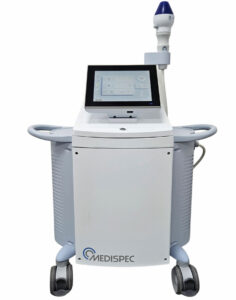
A common pitfall for patients is assuming that all “wave therapies” are created equal. If you are seeking Li-ESWT for Peyronie’s plaque reduction, the specific machine used by your clinic will dictate your results. This is where the Medispec ED1000 has earned its reputation as the industry gold standard.
Many clinics utilize “Radial Wave” devices, which are often marketed under various brand names for “male enhancement.” While these devices can increase surface blood flow, they are technically not shockwaves. They are pressure waves that lose energy the deeper they travel. Because Peyronie’s plaque is often embedded deep within the tissue, radial waves frequently lack the power to achieve true Li-ESWT for Peyronie’s plaque reduction.
In contrast, the Medispec ED1000 uses electrohydraulic technology. It generates a focused, supersonic shockwave that maintains its energy density until it reaches the specific “focal zone”, the exact depth of the plaque. This precision is what allows for measurable Li-ESWT for Peyronie’s plaque reduction where other, cheaper devices fail.
What to Expect During Your Treatment Journey
Choosing Li-ESWT for Peyronie’s plaque reduction is a process, not a one-time event. Because the therapy relies on the body’s internal healing mechanisms, the “remodeling” of the tissue takes time.
- The Protocol: A typical course for Li-ESWT for Peyronie’s plaque reduction involves 6 to 12 sessions, usually spaced out once or twice a week. Each session lasts approximately 20 minutes.
- The Sensation: Patients generally feel a rhythmic “tapping” or “tingling.” Unlike surgery, there is no need for anesthesia, and there is absolutely no “downtime.” You can drive yourself home and resume normal activities immediately.
- The Results: For many, the first sign that Li-ESWT for Peyronie’s plaque reduction is working is a significant reduction in pain during the active phase of the disease. Over the following weeks and months, as the plaque softens, patients often report improved elasticity and a stabilization or reduction of the curvature.
Final Thoughts
If you are navigating the complexities of PD, the phrase to discuss with your urologist is Li-ESWT for Peyronie’s plaque reduction. By choosing a clinic equipped with gold-standard tech like the Medispec ED1000, you ensure that you are receiving the precise energy density required to actually break down scar tissue.
Don’t settle for superficial treatments. Opt for the clinical precision of Li-ESWT for Peyronie’s plaque reduction and take control of your sexual health today.